Are drain Chains Safe for Pipes With Channel Rot?
While we suggest using a Picote Smart Spider in drains with channel rot, we do understand that our customers might


The life expectancy and quality of a shaft depends on selecting the right design.
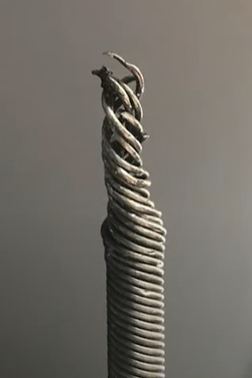
Our flexible shaft is made by winding several layers of high quality spring-grade wire around a single mandrel. Each successive layer is wound onto the shaft at an opposing pitch angle so that you get equal torque in both directions of rotation. The quality of a shaft is determined by the wires used, their number, the diameter, and the annealing temperature.
Properties such as flexibility, torsional stiffness, power transmission, and performance under different speeds are influenced by the selection and adjustment of these fundamentals.
Meeting these basic prerequisites is the guarantee of long, consistent and reliable performance.
The shafts length is measured at the minimum length. We provide the shafts slightly longer than the minimum so that clients can attach their different size tools to the shaft.
The shaft sleeve has friction rings to protect the ends from wear. The friction rings on each end prevent dirt from building up between the shaft and the sleeve. This allows more torque to pass from your drill to the tool end, and makes the system more efficient.
Most experienced users order the kit with a short shaft for everyday use; and a second shaft and connector in the van. The advantage to this is that on a day-to-day basis, you can carry around less shaft with you into your workspace. If you need extra length you can fetch your secondary shaft from your vehicle and connect it to the one you are working with.
Another advantage to having two separate flexible shafts, is that should you accidentally kink the one you are working with, then you have a backup available immediately. No need to find your grinder to cut off the kinked section of the shaft before you can continue working.
The correct method for choosing the right shaft length is to check the layout of your drains and measure the distance between each cleanout point. Ideally, you want a shaft length that either matches the distance between cleanouts or is about half that length. This allows you to reach and clean both upstream and downstream sections effectively, covering the most common blockage areas without using excess shaft length.
The thickness of the shaft depends on the amount of bends that you would like to pass through. The more bends you need to get through, the thinner the shaft should be. However, the thinner the shaft is, the less torque the shaft delivers.
The 6mm (1/4″) flexible shaft is most suitable for 32-50 mm (1.26″- 2″) pipes and can manage to get through multiple bends, but has limited torque, so it is more suitable for blockage removal than descaling. (The 6mm will descale a pipe, but it would take longer to achieve results.
The 8mm (5/16”) flexible shaft is our second most flexible shaft. It has the ability to pass through multiple bends, and has more torque than the 6mm (¼). This shaft is most suitable for pipes with a diameter of 75mm (3”) to 100mm (4”), and will work with blockage removal chains as well as descaling chains.
The 10mm (3/8″) flexible shaft is less flexible than the 8mm (5/16) shaft, and yet more flexible than the 12mm (½”). This shaft will navigate through fewer bends than the 8mm (5/16) shaft, but will offer the user similar torque to the 12mm (1/2″). This shaft is suitable for pipes ranging from 75mm (3”) to 150mm (6”).
The 12mm (½”) flexible shaft is our most rigid shaft. This shaft is popular for failed liner removal since it offers the highest torque ratio. The shaft is perfect for descaling and blockage removal of lines ranging from 100mm (4”) to 250mm (10”)
When we manufacture the shafts we wind them in a long straight line. They are then wound onto a large diameter spool, and later cut into smaller pieces before we assemble them and deliver them to you. This means that when you first use your shaft, you might notice that the ends shrink a little. Usually this is more evident on the drill end.
This is perfectly normal since the shaft is subjected to the stresses of multiple bends and torque for the first time. After the first inner strands of the flexible shaft settle into their permanent position the shrinkage will cease. Usually this affects around 3” (75mm) on either end of the shaft. When you notice this, simply cut off the shrunken section with an angle grinder, and reconnect your chains and drill. It is not necessary to weld the ends, but if you prefer to do this please try to avoid too much heat on the shaft.
Please check out this video for more information about shaft shrinkage.