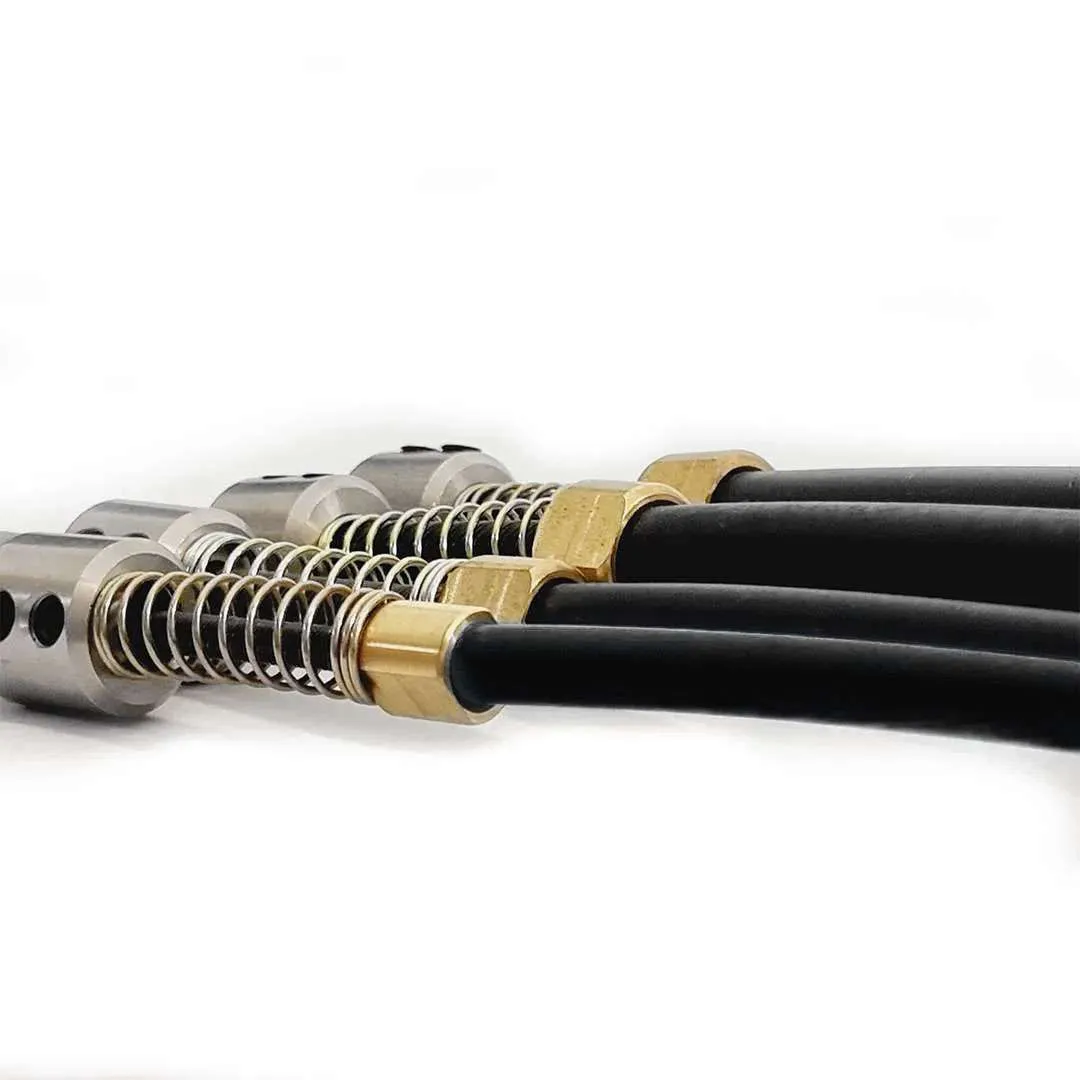
Flexible Shaft Set (Flex Shaft, Sleeve, Friction Rings, Shaft lock & Spring)

€28.95 €426.67Price range: €28.95 through €426.67

Flexible Shaft Set (Flex Shaft, Sleeve, Friction Rings, Shaft lock & Spring)

€28.95 €426.67Price range: €28.95 through €426.67

Flex shaft with a protective sleeve, friction rings, shaft lock and a compression spring used together with sewer cleaning chains to remove blockages and descale pipes.

Description

The Flexible Shaft Set is a professional-grade system designed for drain cleaning, blockage removal, and pipe descaling applications. This set consists of a flex shaft, a protective sleeve, two friction rings, a single shaft lock, and a compression spring.

ALWAYS LUBRICATE YOUR SHAFT BEFORE FIRST USE

Due to aviation regulations, we are not permitted to ship any product that may be considered flammable, so the shafts are delivered without lubricant inside the sleeve.

Shaft Thickness

The thickness of the shaft depends on the amount of bends that you would like to pass through. The more bends you need to get through, the thinner the shaft should be. However, the thinner the shaft is, the less torque the shaft delivers.

  • The 6mm (1/4″) flexible shaft is most suitable for 50mm (2″) pipes and can manage to get through multiple bends, but has limited torque, so it is more suitable for blockage removal than descaling.
  • The 8mm (5/16”) flexible shaft is our second most flexible shaft. It has the ability to pass through multiple bends, and has more torque than the 6mm (¼). This shaft is most suitable for pipes with a diameter of 75mm (3”) to 100mm (4”), and will work with blockage removal chains as well as descaling chains, but it is still most suitable for soft blockages.
  • The 10mm (3/8″) flexible shaft is less flexible than the 8mm (5/16″) shaft, and yet more flexible than the 12mm (½”). This shaft will navigate through fewer bends than the 8mm (5/16″) shaft, but will offer the user similar torque to the 12mm (1/2″). It is suitable for both hard blockages and descaling.
  • The 12mm (½”) flexible shaft is our most rigid shaft. This shaft is popular for failed liner removal since it offers the highest torque ratio. The shaft is perfect for descaling and blockage removal of lines ranging from 100mm (4”) to 200mm (8”).
Shaft Length

The shafts length is measured at the minimum length. We provide the shafts slightly longer than the minimum so that clients can attach their different size tools to the shaft.

Most clients insist on getting the longest shaft possible. Yet, on average, most of the blockages occur within 20m (65ft), and most clean outs are located 25m (82ft) apart. When you choose one of the recommended shafts, please be sure to keep this in mind.

The longer your shaft is, the less torque is delivered to the other end, since there is a slight loss in energy passed through the shaft.

Consider purchasing two shorter shafts with a shaft-to-shaft connector so that you have less to carry around on site, and when you need extra length, you could simply connect an additional shaft. You could also connect a thinner shaft to a thicker shaft to give you flexibility when needed as well as the torque to drive the thinner shaft.

Quality

The lifespan and performance of a flexible shaft depend entirely on its internal construction.

Our shafts are made from spring-grade steel wire, wound around a single mandrel in opposing directions. Each successive layer is wound onto the shaft at an opposing pitch angle. This design allows them to deliver equal torque in both rotational directions.

Shaft shrinkage

During manufacturing, shafts are produced straight, then wound onto large spools before cutting and assembly.
This means you may notice shrinkage of about 75mm (3″) on each end during first use, especially on the drill side.

This is perfectly normal since the shaft is subjected to the stresses of multiple bends and torque for the first time. Once the internal wires settle, the shaft stabilizes permanently.

When shrinkage appears, simply cut off the affected section with an angle grinder and reconnect your tools.

Please do not weld the ends of the shaft after cutting. While many people online may advise doing so, it’s not good for the shaft. It is made from spring-grade steel, which is tempered at a specific temperature and cooled at a specific rate to give it its spring-like properties. Welding changes the cooling process and alters the steel’s characteristics.

General guide to choosing the right flexible shaft:
  • Picote Super Midi is using a 12mm (1/2″) shaft – maximum length 20m (65.6’)
  • Picote Maxi Miller is using a 12mm (1/2″) shaft – maximum length 30m (98.4’)
  • Picote Midi Cleaner is using a 10mm (3/8″) shaft – maximum length 23m (75.5’)
  • Picote Mini Cleaner is using a 8mm (5/16″) shaft – maximum length 16m (52.5’)
  • Picote Mini Miller is using a 8mm (5/16″) shaft- maximum length 16m (52.5’)
  • Ridgid K9-102 FlexShaft® Machine is using a 6mm (1/4″) shaft – maximum length 15m (50’)
  • Ridgid K9-204 FlexShaft® Machine is using a 8mm (5/16″) shaft – maximum length 21m (70’)
  • Milwakuee M18 FUEL High Speed Flexible Shaft Machine is using a 8mm (5/16″) shaft – maximum length 25 m (82’)

Please note that we do not claim to be producing original parts for any of the brands mentioned above.

Set includes:

  • Flexible shaft
  • Protective sleeve
  • 2× friction rings
  • Shaft lock
  • Compression spring

Available diameters:

  • 6mm (1/4") – maximum flexibility, lowest torque
  • 8mm (5/16") – still high flexibility and lower torque
  • 10mm (3/8") – less flexible, higher torque
  • 12mm (1/2") – maximum torque, the least flexible shaft

Available lengths:

  • 2m (6.56ft)
  • 5m (16.4ft)
  • 10m (32.8ft)
  • 15m (49.2ft)
  • 20m (65.6ft)
  • 25m (82ft)
  • 30m (98ft)
  • Custom lengths available on request

Outer diameter (with sleeve):

  • 6mm (1/4") → 10mm OD (0.395")
  • 8mm (5/16") → 12mm OD (0.472")
  • 10mm (3/8") → 15mm OD (0.591")
  • 12mm (1/2") → 18mm OD (0.709")

Important: Using an imperial Allen key may strip the set screws. We recommend using a metric Allen key instead.

A screw set with metric Allen keys can be found here.

  • Pipe blockage removal
  • Pipe descaling
  • Sewer line cleaning
  • Root intrusion removal
  • Liner and deposit removal (heavy-duty applications with larger shafts)

Selection guide:

  • 6mm (1/4") → Best for 38mm-50mm (1.5"-2") pipes, tight bends, light blockage removal
  • 8mm (5/16") → Ideal for removing soft blockages (such as grease) in 75–100mm (3"-4") pipes, not so much for descaling
  • 10mm (3/8") → Medium pipes, fewer bends, higher torque demand, both tough blockages and pipe descaling
  • 12mm (1/2") → 100mm–200mm (4"-8") pipes, heavy descaling, stubborn blockages and liner removal; the least flexible shaft

We recommend pairing 6mm (1/4") and 8mm (5/16") shafts with lightweight chains, while 10mm (3/8") and 12mm (1/2") shafts should be used with heavy-duty chains for optimal results.


Important notes:

  • Always lubricate the shaft before first use (shaft is shipped dry due to transport regulations) and then check the lubrication every few weeks
  • Shaft performance decreases with excessive length due to torque loss. For optimal handling, consider using shorter shafts with connectors for extension
  • Initial use may cause minor “settling” (shaft shrinkage of ~75mm per end), which is normal and can be cut off with an angle grinder

Points to note

You may also like…